
Sugar Mountain
you're leaving there too soon

One of Neil Young’s most popular songs is Sugar Mountain; it’s a song about youth and then the first stages of adulthood just after. The early twenties, once you emerge from the cocoon of family life with parents, and when you finally get out on your own without supervision. If you look the song up on Wikipedia, you will find this description:
"Sugar Mountain" is a song by Canadian folk rock singer and composer Neil Young. Young composed the song on November 12, 1964—his 19th birthday—at the Victoria Hotel in Fort William, Ontario (now Thunder Bay), where he had been touring with his Winnipeg band the Squires. Its lyrics are reminiscences about his youth in Winnipeg, Manitoba.
It is widely known that the contrarian Ontarian only performs the song because his dying fans cannot get enough of it! "I do 'Sugar Mountain' really for the people more than I do it for myself.” said the man who penned the line "It's better to burn out than to fade away". The older I get, the more that I seem to appreciate the old Neil Young of my youth— not the hostile aging old Cogger I see on stage these days— but rather the serious and thoughtful lyricist of his twenties. The guy who always did better on his own, or at least seemed to be better suited to being alone; the guy who wrote that haunting song about the old man. Now Neil Young is that old man.
Can you think of a song that captures the essence of nostalgia better than Sugar Mountain? Nostalgia is a kind of run of the mill emotion; I can certainly see why Young was not interested in the song much until he became old. Nostalgia is an emotion that very few people feel in their forties. Nostalgia is a fine Cabernet among more complicated wines. Reportedly Young enjoys playing the song now that he is approaching eighty, so it is bound for a resurgence of interest, or perhaps a popular new cover. It’s a great song that has always resonated with me, due to the simplicity of its lyrics, the sentiments expressed, and the haunting melody.
Joni Mitchell, also an Ontarian Canadian, wrote the song The Circle Game, inspired by Sugar Mountain and enamored by Young who she met on the folk music scene after Young left his rock and roll band and set out on his own, for the very first time in 1966. This would be a pattern that would repeat itself through the sixties and seventies. Young joining a band and then quitting them just as fast. Joni Mitchell, on the other hand, would go on to have an equally successful and satisfying career, staying close to and collaborating with loyal bandmates and accomplished musicians such as Tom Scott and Charles Mingus, the whole while. The kind of behavior that you would expect from a neighbor to our north.
Her song, The Circle Game, was made famous by Tom Rush, who was an important folk singer of the sixties, originating out of the Boston North Shore area where I grew up. I saw him play a few times and he was pretty good. He used to play a favorite dinner and show joint in Fitchburg Mass called the Bull Run. A real guitarist with a rich voice. Commanding figure on stage who grew up in Portsmouth New Hampshire and attended all the right schools, before becoming a serious act. Someone that I suspect was on a first name basis with Bob Dylan, Joan Baez, Jerry Jeff Walker, and Al Kooper back in the day. A guy who stuck to his guns and never aspired to be a popular act. Happy to play his music, avoid the hoopla, and sell a few albums. A notoriously nice man.
Around this time in 1969 in the Appalachian mountains of North Carolina, a small group of skiers and investors opened a ski area called Sugar Mountain. It is unlike any other ski area in the Southeast. With steep pitches and some narrow trails, Sugar Mountain was instantly more skiable than the Old Snows Mountain at Waterville Valley, the infamous Black Mountain, or the iconic Mount Cranmore outside of Conway NH, a real ski town much further north. With ample vertical drop, Sugar Mountain comes up short when measured against Cannon Mountain, Wildcat, and Sugar Loaf which all came before, but it has more character and varied terrain than say Attitash Mountain, Snowshoe, or any of the resorts in the Poconos which all came after. A ski resort with 1,200 vertical feet of drop and varied, steep terrain is considered decent on the east coast.
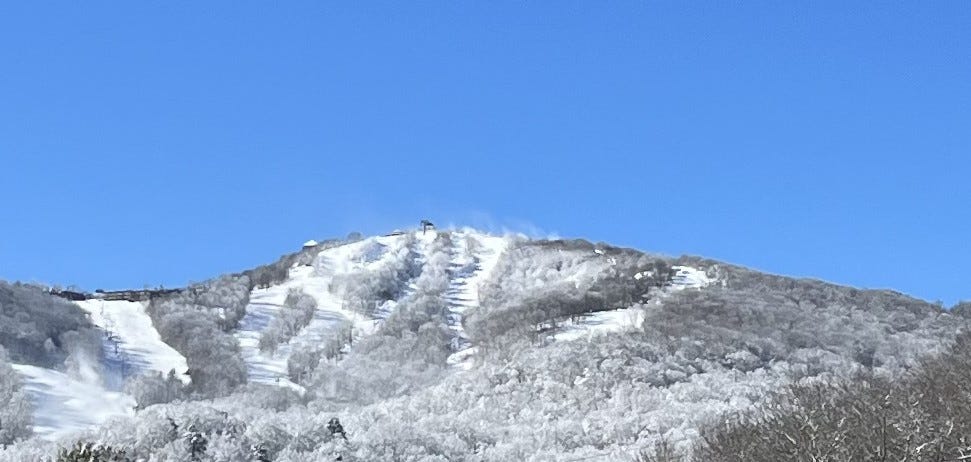
When the history book of lift served ski areas finally gets written by the ambitious and talented Stuart Winchester, substack author of the Storm Skiing Journal, there should be a single chapter on Sugar Mountain and the audacity of it’s aspirations. It is a really spectacular ski resort located well below the Mason Dixon line and just a short ride to the Queen City of North Carolina, the financial center of the south, Charlotte. It is a awe inspiring sight when it finally comes into view; as disconcerting as hearing a southern drawl on the chairlift to the top. You stop to pinch yourself, to check your senses; is this real or am I just dreaming? There is no way that you can ski Sugar Mountain without thinking that this place was conceived by serious skiers; it is a very skiable mountain that gets plenty of snow.

Then you notice the giant eyesore nearby. The students at nearby Appalachian State call it the Sugar Cube. It is a concrete, multi story condominium building that could double as soviet era, state sponsored housing. Set atop and against a backdrop of beautiful mountains, the Sugar Cube appears as a vile reminder of the greed of men. It is so ugly that it single handedly sparked legislation that made it absolutely impossible for anything so ugly to be built, so conspicuously, in North Carolina. Ever. Thankfully. Makes you wonder how it got there. What went wrong twenty years after the mountain opened, that allowed such a thing to happen? The eighties!
But back to the the skiing. It was better than I remembered. I skied at Sugar Mountain back in 2008 in mid December. There was top to bottom skiing on Gunther’s run at that time, but not much more. This time around, I arrived soon after a dump, when every lift was running and every trail was open. The only areas that were roped off were under the lifts where they cannot groom and in the woods which they have not really thinned for skiers. I slid under a rope anyway and got a reprimand (a warning and an old school X mark on my ticket) but it was worth the effort to make a few turns where no one else had. Sort of like when my dog Sebastian pees on meaningless shrubs in the park; he is making a statement and nothing more.
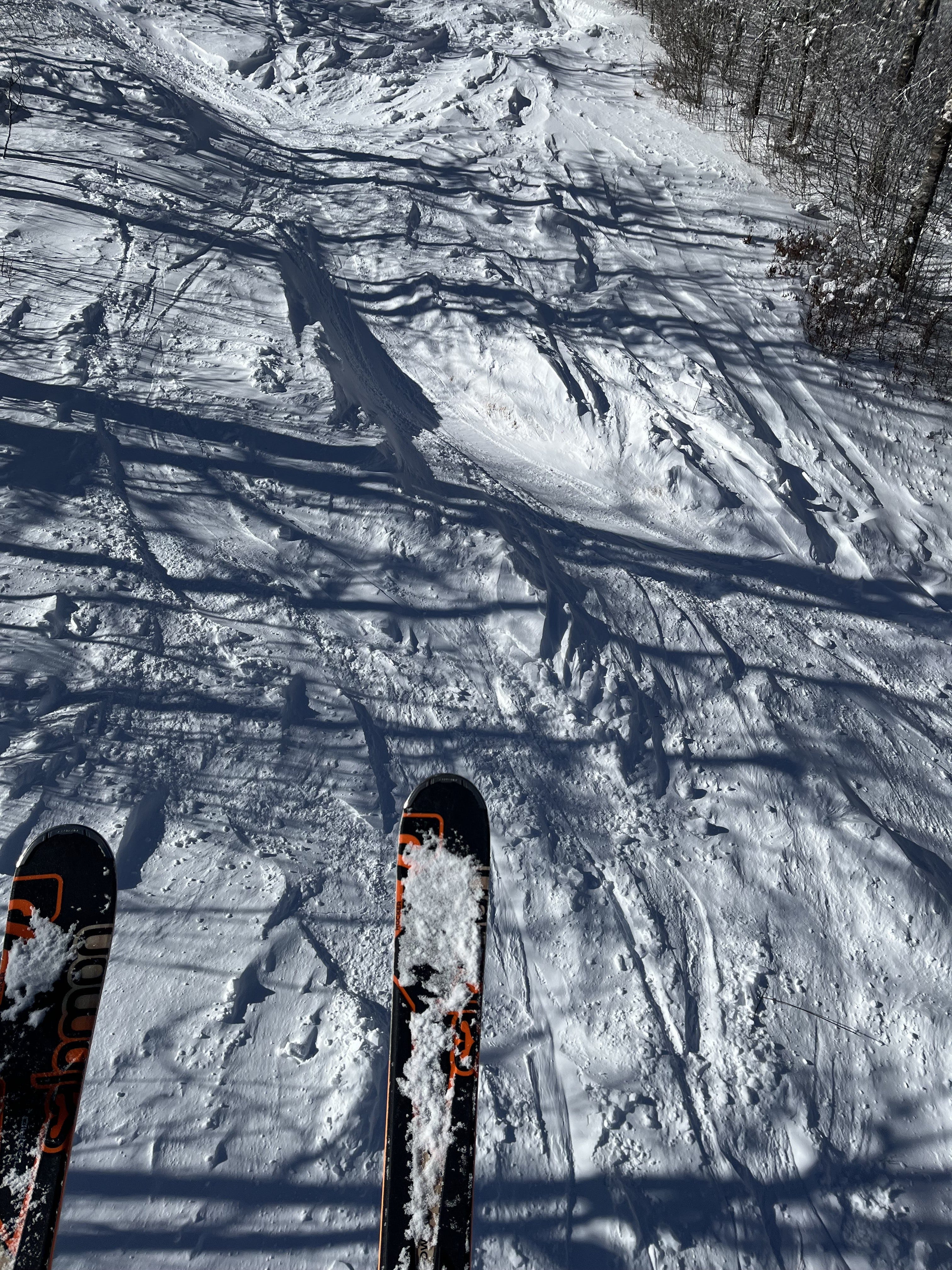
Sugar Mountain has three things going for it: Tom Terrific, Balderdash, and Whoop-de-do. These three trails are steep enough for me. One hundred yards of thirty degree or more of sheer, delightful terror. I found that the sides of each trail held snow well enough; the problem with these trails is a familiar one to eastern skiers and that is slope underneath is sheer ice, especially in the middle of the trail, where the snow is continually warmed and cooled. The top of Balderdash may be closer to forty degrees. It is what we used to refer to as a headwall. For me, it was reminiscent of the Genevieve Chute at Telluride and my ill fated uncontrolled slide from a few years ago. I took it easy and sidestepped my way down one really dangerous pitch on it.
I teamed up with a ski patroller to tackle Whoop-de-do which was a hoot as its name implies. He left me in the dust, but only becuase he didn’t know how to link turns together really fast. I do not want to stereotype southern skiers, but I think that they they have watched too many NASCAR races. They bomb when they should weave; the foot is always on the gas and not enough attention is paid to the turns. But hey who am I to judge? The bottom line is that the guy was solid on his feet and he flew off as if getting the green light at a drag race.
Tom Terrific is just an excellent trail that reminded me of my youth skiing in the white mountains of NH. A narrow, rolling trail with steep pitches followed by a flat spot to stop or check your speed. A trail that holds the snow well and is in the lee of the prevailing wind so it accumulates inches quickly. The oldest trails at the top of Cannon Mountain come to mind; Narrow Gauge on Sugarloaf, before they widened it years ago. I did three Terrific runs before I decided to revisit the signature groomer, Gunther’s Way at Sugar Mountain.
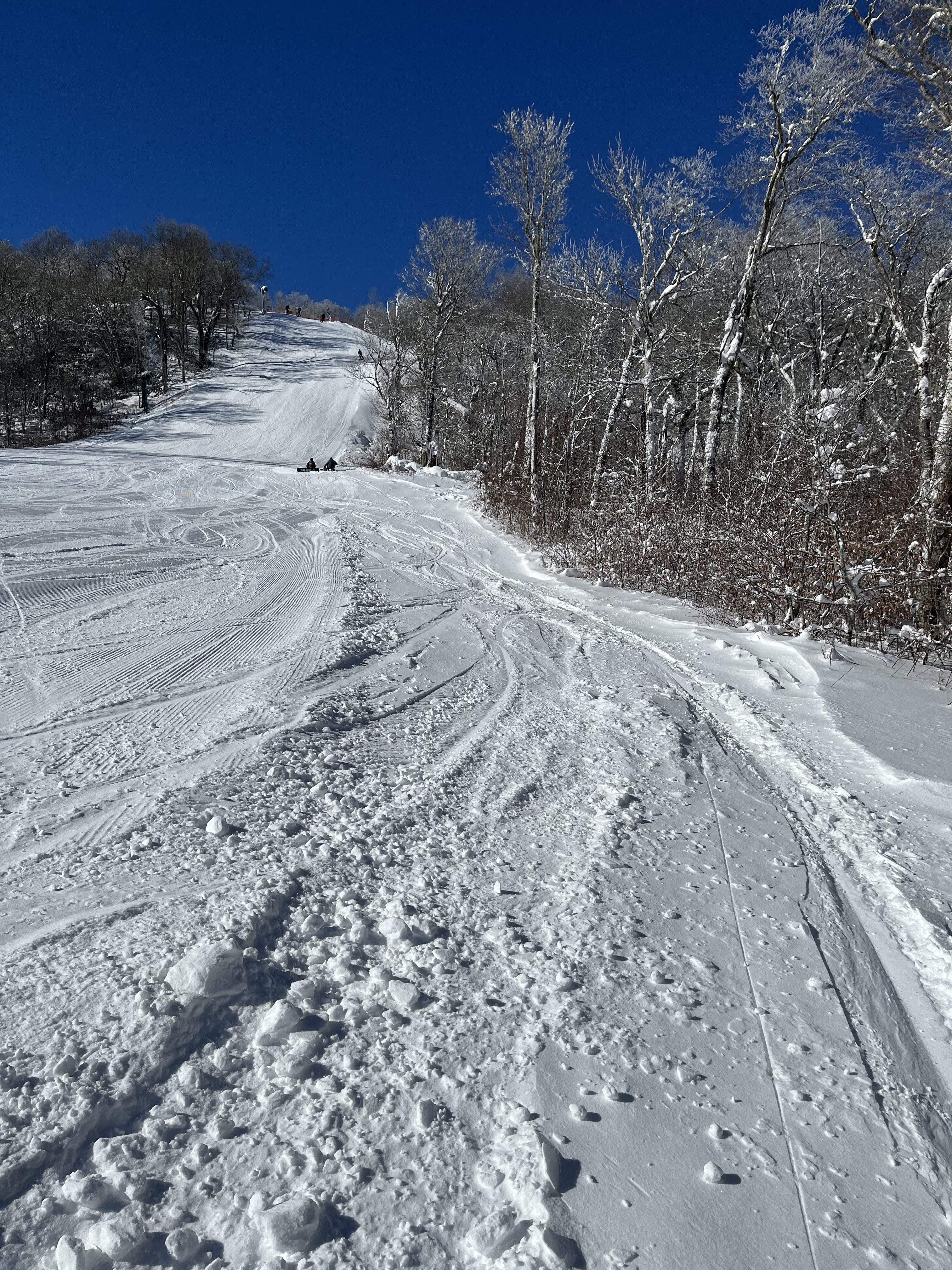
The first thing I am going to tell you about this trail is that it feels like it is two miles long. It is the kind of trail that you can do without stopping, but it is highly likely that your thighs will burn and you might even feel your calves cramp up. From top to bottom it has a nearly perfect pitch: steep enough so that you have to keep turning frequently to check your speed, but not so steep that you have to slow down at any point in the run. You can air it all out; the trail keeps getting wider as you near the bottom. It feels somewhat claustrophobic at the top of the run because it is the only easy way down from the top. For your average, run of the mill, weekend warrior skier, it is a great experience. You get off the chair at 5,000 ft. above sea level and you ski down a manageable slope that maintains its difficulty through to the bottom. And you are never under a lift!
I spent enough time on the mountain to experience nostalgia for my youthful ski days in the late sixties when I was coming of age in life and on skis. A trip to Sugar Mountain brought back a lot of wonderful skiing memories, skiing with my parents at the old Snows Mountain at Waterville Valley before Mt Tecumseh was opened, a ski trip to Sunapee mountain with my oldest brother Kenny as an early adolescent. A week that my brother Richard and I spent during a break from high school, staying at a hostel in the white mountains and skiing Wildcat, Cranmore, and Attitash. We drove around Conway at nigh in a copper, ragtop ‘66 mustang that handled poorly in the snow, and tried to find girls to impress.
Sugar Mountain, both the song and the ski resort, is synonymous with nostalgia for me. Nostalgia comes from the Greek words Nostus which means the return and Algos which means pain. The literal meaning of nostalgia, is the painful experience suffered by the desire or hankering to return to a place of origin. It is the realization that you can never go back; even if you do, you have been changed by time, and the experiences of your youth cannot be recaptured. It is different from homesickness in the sense that it is the feelings that are missed and not the actual things. The emotion of nostalgia is often triggered by the senses, a smell, a sound, or a memory, a place.
For me, on this recent trip to Elk Banner NC, the sensations of nostalgia were even more powerful after I spent a few hours at the nearby Beech Mountain. Lacking imagination, great terrain, and an original vibe, this newly constructed ski resort features a lot of amenities that are attractive these days. A huge and efficient rental shop, a mountainside brewery, and plenty of spaces to hang out and take selfies when not skiing. In short, everything that Sugar Mountain is not. However ironically there is no Sugar Cube at Beech and everything is quite tastefully done; it is just not a very good place to ski unfortunately, even at its lofty elevation, the highest in the East. Beech only invokes less than enjoyable experiences on snow, at cheesy ski areas where you go when there is no other reasonable alternative.
I’ve have always loved the Neil Young song Sugar Mountain. Occasionally I will find myself humming the song or mouthing some of the lyrics, as I go about a chore or task that reminds me of my youth. I am also overwhelmed by nostalgia when riding a chairlift alone, feeling little and insignificant, on a crisp and cold morning, when the mountain snow squeaks under your skis, anxious to tackle something really big and audacious. Sugar Mountain makes no excuse for being a real skier’s ski mountain in North Carolina; it has the confidence to be judged on the basis of its merits. There is something very nostalgic about that kind of old school attitude for me.